
This brachiopod fossil is a rare example of the Spiny brachiopod Class: Lingulata (Order: Siphonotretida, stem group brachiopods)
Fossils of Australia
This brachiopod fossil is a rare example of the Spiny brachiopod Class: Lingulata (Order: Siphonotretida, stem group brachiopods)
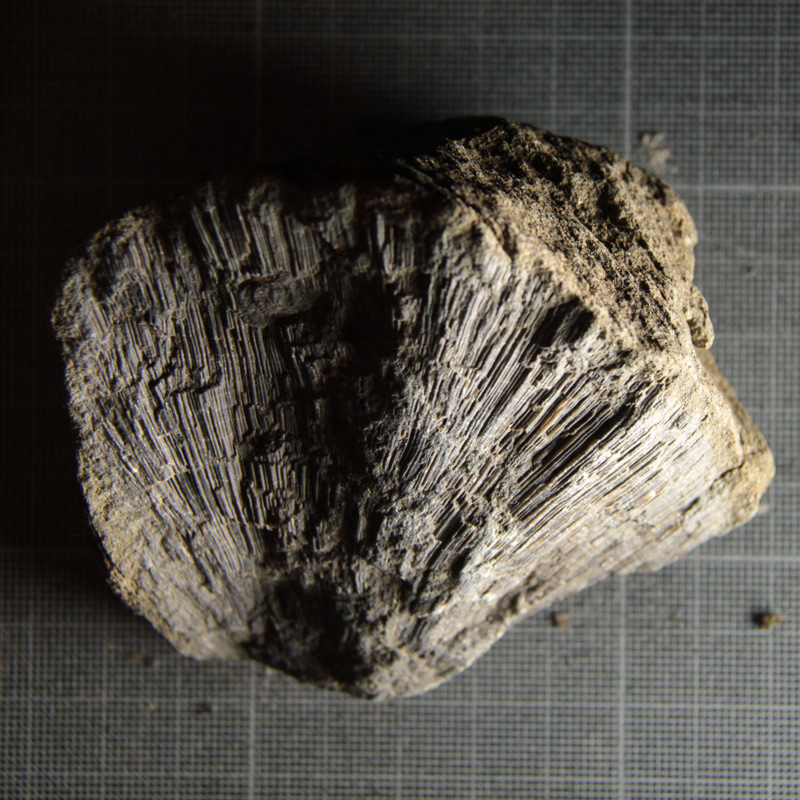
Bryozoan
Stenopora bryozoan was an aquatic invertebrate similar to coral but belong to a completely different phylum. They individual tubules of the ‘fan’ were inhabited by small colonial animals called zooids. The zooids were filter feeders that fed on organic particles washed around by the ocean currents. Specimen from the South Coast of NSW.

Spiriferid are brachiopods filtering feeders that fed on organic particles washed around by the ocean currents. The valves (each shell side) has pronounced folds and sulcus (furrow, fissures). They lived in mud by anchoring to the sea floor with a fleshy stalk called a pedicle that protruded from the shell’s hinge. Specimen from the South Coast of NSW.

Marine bivalve mollusc filter feeder lived in shallow marine environments attaching themselves to rocks or hard surfaces. They have compressed bodies enclosed by a shell in two hinged parts and are similar is shape to the Shell Oil logo and are related to clams, oysters, mussels. Specimen from the South Coast of NSW.
http://en.wikipedia.org/wiki/Bivalve_molluscs

Gastropods are molluscs related to living gastropods of today like snails and slugs. The fossil history of this Gastropoda goes back to the Late Cambrian. There are 611 families of gastropods, of which 202 families are extinct. This is a specimen from the South Coast of NSW.
http://en.wikipedia.org/wiki/Gastropod

Crinoids are echinoderms, filter feeders related to starfish that lived in shallow marine habitats. Most of the Paleozoic Crinoids forms died out in the great Permian extinction however Crinoids are still alive in oceans today. This is a specimen from the South Coast of NSW.
http://en.wikipedia.org/wiki/Crinoid

Cephalopods are the group of animals that includes the octopus, cuttlefish, squid and the nautilus. Cephalopods evolved from primitive molluscs during the Late Cambrian, approximately 500 million years ago. In primitive cephalopods like the one above its shell was external and superficially like that of a gastropod snail. Such a shell serves two functions: defence and buoyancy. The fossil above is possibly that of a Orthoceras Cephalopoda. Cephalopod from South Coast NSW Australia.
http://en.wikipedia.org/wiki/Cephalopods

Conulariid
Conulariid / Conulata was a marine filtering feeder that fed on organic particles washed around by currents. They resemble a four sided cone made up of rows of calcium phosphate rods. They lived anchored to hard objects by a flexible stalk and often lived in groups. The fossil above is a good example of a Conulariid. Possibly in the Genus Notoconularia inornata. Fossil specimen from the South Coast of NSW.

Glossopteris Leaf
Glossopteris is the largest and best-known genus of the extinct order of seed ferns known as Glossopteridales. Glossopteris was a dominant plant throughout the Permian and much of the Illawarra Coal Measures are made up from the deciduous leaves that the plant dropped in the cooler seasons. They disappeared in almost all places at the end of the Permian. This example is of a leaf that is apparently similar in appearance to a tongue, the name Glossopteris comes from the Greek word ‘glossa’ which means tongue. Specimen from the Illawarra of NSW.
http://en.wikipedia.org/wiki/Glossopteris

Glossopteris is the largest and best-known genus of the extinct order of seed ferns known as Glossopteridales. Glossopteris was a dominant plant throughout the Permian and much of the Illawarra Coal Measures are made up from the deciduous leaves that the plant dropped in the cooler seasons. They disappeared in almost all places at the end of the Permian. This example is of part of the root system and is know as vertebraria, similar in appearance to a backbone which is why it was given this name. Specimen from the Illawarra of NSW.
http://en.wikipedia.org/wiki/Glossopteris