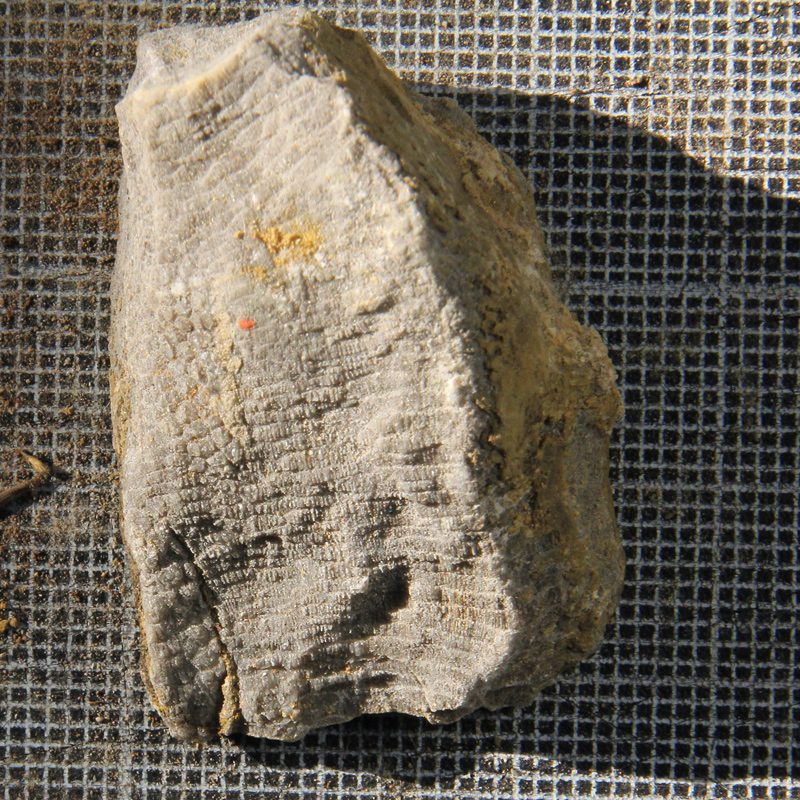
compound rugose coral
Rugosa (colonial), gen. indet.
- Catalogue
- FA-0253
- Phylum
- Cnidaria
- Class
- Anthozoa
- Locality
- Yass district, New South Wales
- Unit
- not recorded
- Age
- Late Silurian (Ludlow–Přídolí)
427.4–419.2 Ma - Reference
- Wikipedia
A colonial rugose coral, in which many individual corallites are packed together into a single mass. Where the corallites press against one another they take on a honeycomb-like outline, which makes colonial rugosans easy to confuse with tabulate corals such as Favosites.
The way to tell them apart is the internal structure. Rugose corallites carry prominent vertical partitions — septa — inserted in a distinctive order as the animal grew. Tabulate corals have weak septa or none at all.
Note on the identification
Both colonial rugosans in this collection were originally catalogued as Hexagonaria. That genus is essentially Devonian and would be out of place in a Late Silurian fauna from Yass, so the name is not used here. Silurian colonial rugosans from these beds are more likely to be Entelophyllum or a related form. Settling it would need a thin section cut through the corallites.
Also in this collection under the same name: FA-0178